May-king Hay
May Day, once a pastoral celebration of summer, became a pivotal date in American labor history following an 1884 proclamation by the Federation of Organized Trades and Labor Unions. Their May Basket gift to industry was a May 1, 1886 deadline for the eight-hour workday and threatening a national strike.
Moderate Progressive efforts secured concessions for roughly 50,000 workers by April 1886 but the movement was complicated when anarchists adopted the cause. Their calls for violent revolution tainted public and industrial perception. When the deadline passed, 400,000 workers struck nationwide. In Chicago, tensions peaked on May 3 during a confrontation at the McCormick Reaper plant, where police killed several workers.
In response, anarchists organized a protest at Haymarket Square on May 4. As police dispersed the crowd, a bomb was thrown, killing several officers and protesters. Despite a lack of direct evidence, eight anarchists were convicted of conspiracy based on their radical rhetoric. Under 19th-century legal standards, their speech was ruled as the inspiration for the bombing. The subsequent executions drew international attention and left indelible marks on the path of global labor reform and First Amendment protections in the US.
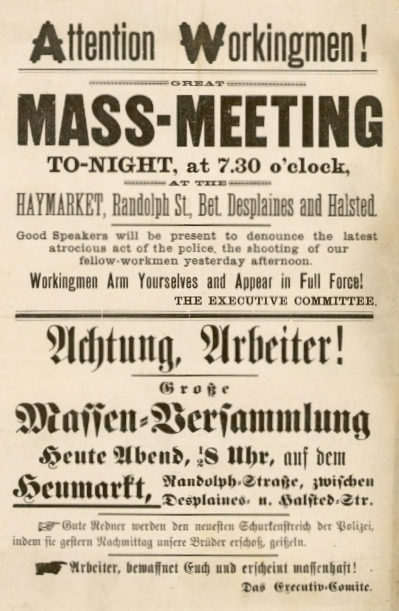
Attention, Workingmen!
Organized labor efforts were initially set back but the seeds for lasting reform were planted. Anarchists were rightly vilified and employers revoked many previous concessions on working hours. New unions like the American Federation of Labor tried to shift the focus to legislation rather than rhetoric. Socialists resisted moderation and declared May 1st as International Workers’ Day specifically to commemorate the Haymarket “martyrs”.
Government, labor and business in the US took an unsurprisingly pragmatic approach. President Grover Cleveland had sent in federal troops to firmly suppress the Pullman Strike of 1894. At the same time, he rushed legislation through Congress that established the 1st Monday of September as Labor Day in the US. This served as a peace offering to labor while avoiding association with the more radical elements and the memory of Haymarket.
Most importantly, the Haymarket trial was a clarifying moment on the First Amendment. The executions of the Chicago Eight were “correct” according to the law of the time. On the other hand, our country’s Founders viewed even speech calling for revolution as an inalienable human right. After the trial, judges began to work toward criminalizing only egregious offenses like direct, immediate incitement to violence. The antidote to bad speech, they contended, is more speech. This is a social problem not a legal one. Today’s calls to police what the other team says show this tension is far from resolved and that the American project is more than capable of handling it.